Translational regulation of osk mRNA
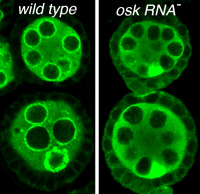
The Osk protein is tightly restricted to the posterior pole of the oocyte, where it recruits factors required for provision of determinants that direct posterior body patterning and germ cell formation. If Osk is allowed to spread outside this region, body patterning is reprogrammed (a lethal event) and ectopic germ cells form (Smith et al. 1992). To achieve this restriction of Osk protein, osk mRNA is very effectively localized to the posterior of the oocyte (Kim-Ha et al. 1991; Kim-Ha et al. 1993), and translation of osk mRNA is tightly regulated (Kim-Ha et al. 1995).
Bruno binds to specific sites in the osk mRNA (Bruno Response Elements, or BREs) and represses translation of osk mRNA prior to its localization. In past work in this area we first identified Bruno and the BREs (Kim-Ha et al. 1995), then identified arrest as the gene encoding Bruno (Webster et al. 1997), and developed in vitro translation extracts from Drosophila tissues to prove that Bruno represses osk mRNA translation (Lie and Macdonald 1999b). In related studies we also found that the Vasa and Apontic proteins bind to Bruno (Webster et al. 1997; Lie and Macdonald, 1999a), and we identified a number of genes that interact genetically with arrest (Yan and Macdonald, 2004).
Our analysis of osk mRNA translation also revealed a surprising phenomenon: osk mRNA is associated with polysomes even in mutants in which Osk protein accumulation is largely eliminated (Braat et al. 2004). Certain mRNAs that are translationally repressed by microRNAs (miRNAs) are also found associated with polysomes, raising the possibility that miRNAs provide one level of translational control of osk mRNA.
Current work is aimed at better defining and characterizing the molecular interactions of Bruno, and determining how these interactions contribute to Bruno function. To assay mutant forms of Bruno we developed an ectopic expression assay, in which Bruno expressed from a transgene interferes with a late and essential phase in osk expression (Snee et al. 2007). In ongoing projects we have explored the RNA binding activity of Bruno and its interactions with protein binding partners (multiple manuscripts in preparation).
Cytoplasmic RNPs
Studies on transcriptional regulation began with a focus on cis-regulatory elements (promoters and, later, enhancers) and trans-acting factors (RNA polymerase and transcription factors). Elucidation of the details of the basic transcriptional apparatus and its operations using naked DNA and purified proteins was followed by a growing interest in the cellular substrate for transcription: chromatin. We now know that chromatin has a dynamic structure and exerts substantial control on transcription. Similarly, it seems very likely that subcellular context will be an important part of post-transcriptional regulatory events in which the participants are well defined cis-acting elements (such as BREs) and individual regulators (such as Bruno).
There are several large RNPs in the ovary: nuage, sponge bodies, and polar granules. Nuage occupies a perinuclear position in the nurse cells, sponge bodies are more cytoplasmic, and polar granules are assembled only at the posterior pole of the oocyte.
We are studying several of these RNPs, characterizing their makeup, relationship to one another, and functions. One notable feature is the overlap in components, with many proteins present in more than one type of RNP. This overlap is particularly striking iun a comparison of nuage and polar granules, leading us to ask if nuage particles are precursors to polar granules. Using a combination of live imaging and photobleaching methods we found that polar granules are assembled de novo (Snee and Macdonald, 2004). Current efforts focus on sponge bodies and nuage, as well as the RNPs containing mRNAs under control of miRNAs.

Ectopic germ cells from overexpression of Oskar
Altered nuclear body morphology from D. immigrans Oskar expression in D. melanogaster germ cells.
Germ cell formation and function
Polar granules, described in the previous section, are implicated in germ cell formation. Early transplantation experiments demonstrated that transfer of polar cytoplasm to a different position in the embryo led to ectopic germ cell formation at that site. More recently, mutants lacking polar granules have been shown to be defective in germ cell formation.
Oskar protein is a key player in polar granule formation. Oskar appears to function by nucleating formation of the granules, and recruits other granule components. To ask if Oskar acts only in the initial formation of polar granules during oogenesis, or if it has a continuing role, we took advantage of morphological differences in the polar granules of D. melanogater and D. immigrans. Although polar granules of both species are initially similar in morphology, during early stages of embryogenesis the D. melanogaster granlules adopt a spherical shape while the D. immigrans graules become rod-like. We expressed the D. immigrans oskar gene in D. melanogaster flies, and found that the granules were converted to the rod-like morphology. As part of this work we also found that Oskar is present in nuclear bodies, structures similar in morphology to the polar granules but found in the nuclei of embryonic germ cells (polar granules are cytoplasmic), and that the D. immigrans Oskar protein converts the nuclear bodies to the D. immigrans morphology. Thus, the function of Oskar is not limited to the well known role of nucleating polar granules formaiton during oogenesis, but also has a continuing role in embryonic germ cells (Jones and Macdonald, 2007).